What does AI need to know to write something useful about your company?
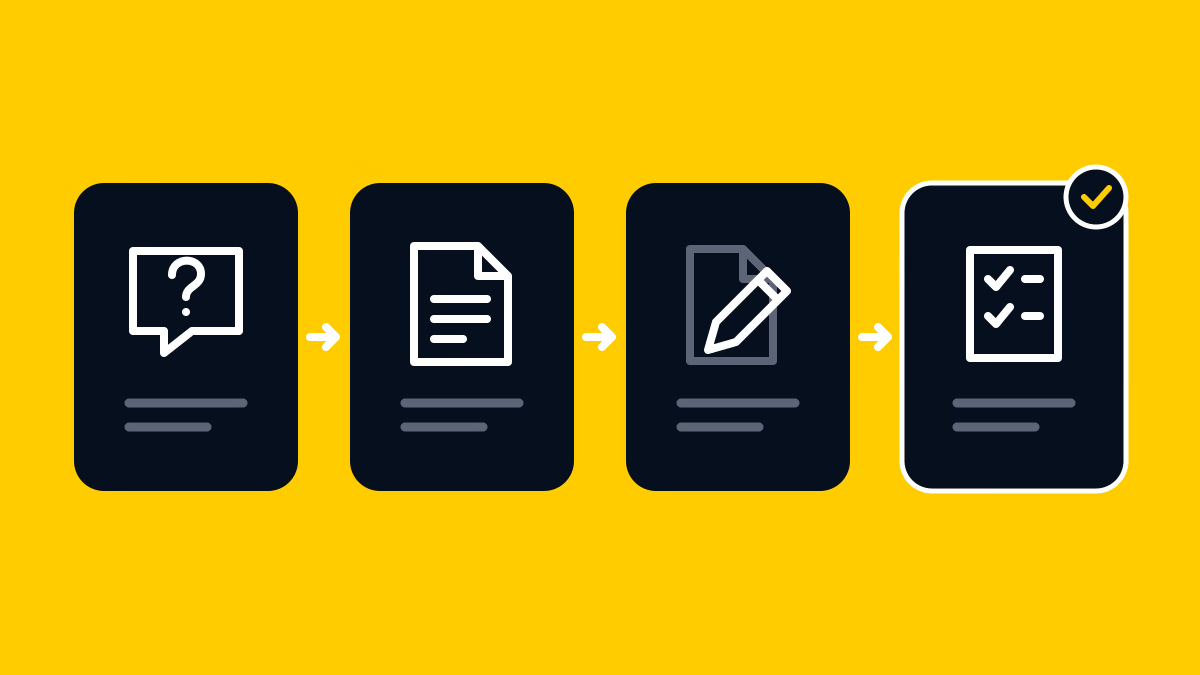
Before asking an artificial intelligence (AI) assistant to write about your company, give it the reader’s question, relevant company material, a defined task and clear boundaries. Organise the work in four stages: decide what the article must answer, check the materials, assign the writing and review the draft. When a gap appears, decide what can proceed and what needs clarification.
Here is a fictional example involving a company that inspects warehouse roofs. The company, documents, internal note and suggested wording are invented for this explanation. They do not describe Supasaito or a real customer. We will follow the marketing coordinator from preparing the request through to the service owner’s review of the draft.
1. Turn the sales question into an article question
The marketing coordinator receives this note from sales:
Sales note
Prospective customers ask whether the inspection visit also includes fixing leaks.
The coordinator decides to prepare an article explaining the service. But simply asking AI to “write a blog article about our roof inspection service” would leave the main question unstated.
Before commissioning the draft, they identify the reader: a warehouse facilities manager considering an inspection. They then define the question the article must answer:
Does a roof inspection include repairs?
That decision determines which information to find next. The coordinator needs material establishing the inspection’s inclusions and how repairs are handled. They do not need to begin by collecting the company’s entire history.
If you are unsure what an offer needs to explain, the Clarity section of our Visibility, Clarity and Trust article considers audience, scope, conditions and exclusions.
At the end of this stage, the coordinator has more than a subject. They have a question for a particular reader, which guides the choice of supporting material.
2. Select and check the material that answers it
The coordinator finds a service sheet whose contents the service owner has checked. This passage is also fictional:
Service sheet
The roof inspection includes a site visit, photographs and a written findings report. Repairs are quoted separately.
There is now a basis for the article’s answer. The service sheet establishes scope; the earlier sales note explains why the article is needed. A question about repairs does not establish that repairs are included.
Google’s Gemini API prompt design guide similarly describes supplying relevant reference material instead of assuming the model already has the information needed. Here, the coordinator will provide the relevant passage rather than ask the assistant to infer the offer from the company name.
Missing or conflicting information can surface while preparing these materials. Suppose the coordinator also wants to explain when the report arrives. The sheet does not say. They can ask the service owner, or leave out that commitment and keep the article focused on inspection scope. The missing delivery time does not prevent answering whether repairs are included.
A different problem would arise if an old draft said repairs were included. That conflict affects the central answer. The coordinator should show the passages to the service owner and establish the current scope before using the disputed claim.
The purpose of this stage is to establish what supports the explanation, rather than simply add documents. Anthropic’s September 2025 article on context engineering for AI agents recommends selecting relevant information while retaining enough detail to guide the work. Its engineering advice does not establish an optimal amount of material for this article assignment.
For your own materials, check that they reflect the current offer, identify who checked them, and confirm that you may share them with your chosen tool. If the assistant can already read the relevant approved files—for example, documents you have uploaded or files in a connected folder—you do not need to paste their contents into the request again. Check that it can open the material you want it to use: mentioning a filename or sharing a link does not, by itself, mean the assistant can read it.
In this example, the coordinator includes the full service-sheet passage and sales note in the request. With the evidence and its gaps identified, they can specify the writing task.
3. Assemble the assignment and request the draft
The coordinator now defines the deliverable, boundaries and reviewer. “Prepare an article draft” is the task. “Repairs are quoted separately” is a source-supported company fact. “Explain necessary terms in plain language” is a writing preference.
Keeping those roles distinct makes clear what the assistant should produce and what it should use as evidence. Anthropic’s Claude prompting guidance recommends explicit outputs and constraints, with an explanation of the task’s purpose.
The coordinator labels the service sheet Source 1 and the sales note Source 2, includes their text, and makes this request:
Prepare a blog article draft for warehouse facilities managers answering: “Does a roof inspection include repairs?”
Use Source 1 as the basis for statements about our service scope. Source 2 explains the question that prompted this article.
Explain that the inspection includes a site visit, photographs and a written findings report. Make clear that repairs are quoted separately. Do not imply that requesting the inspection also commissions repairs.
Do not add prices, report delivery times, certifications, guarantees or customer results that the sources do not establish. If information needed for the explanation is missing, list the question separately from the article draft. If the documents conflict, identify the conflicting passages and ask for clarification.
Use clear, calm language and explain necessary specialist terms. The service owner will review the draft against Source 1. This request does not include publication.
The missing report time identified during preparation has become a writing condition: do not add an unsupported delivery commitment. What the coordinator learned while checking the material now carries into the assignment.
If they also supply a writing example, they should label it separately from evidence about the service. A delivery promise in a style example must not become a company commitment simply because its wording is appealing.
The reader, question, sources, scope, uncertainty handling and reviewer are now collected in one request. This is Supasaito’s practical way to organise the work, not a mandatory input format shared by every assistant. Once the draft returns, the next step is to compare it with that request and its sources.
4. Review the draft and resolve what remains
Here is a possible passage constructed to illustrate the review stage. It is not an observed model response or evidence of an improvement caused by the assignment:
The roof inspection includes a site visit, photographs and a written findings report. Repairs are quoted separately, so requesting an inspection does not mean repairs are included.
The service owner places the assignment, service sheet and passage side by side. They check that the visit, photographs and written report are present, that repairs remain separately quoted, and that no unsupported delivery time or guarantee has appeared.
This is where wording that departs from the assignment may be found. If a draft says repairs are included, the reviewer points out the mismatch with Source 1 and requests a correction. If it adds a report delivery time, they remove the commitment or confirm it with the service owner if it is needed. Even though the assignment explicitly says not to add a report delivery time, the reviewer still needs to check that the draft has not introduced one.
Anthropic’s guidance on reducing hallucinations acknowledges that Claude can produce text inconsistent with supplied information. It recommends measures such as allowing uncertainty and restricting factual answers to provided documents. Those measures do not guarantee correctness.
After checking and correcting the draft, the reviewer can leave a short note: “The inspection inclusions and separately quoted repairs match Source 1. We could not confirm the report delivery time, so the draft makes no promise about it.” Anyone reviewing the article later can then see what was checked and why the delivery time was left out.
The reviewer also distinguishes matching the service sheet from confirming that the sheet reflects the current offer. Our guide to checking AI citations explains that difference between support for a sentence and the suitability of its source.
The job in this example ends with a checked draft, before publication. Keep the assignment, source material, corrected text and review note together so the person handling the next stage can follow the basis for the wording.
For your next article, begin with the reader’s question. Check the material that answers it, turn that material into an assignment, then compare the returned text with what you supplied. Each stage should carry its decisions and unresolved questions into the next.
FAQ
- Do I need to provide every company document?
-
Start with the materials relevant to the question the article must answer. A broader task may require more information, but collecting more documents is not the goal in itself. Check that you may share the selected information with your chosen tool.
- Are the company name and website URL enough?
-
They do not, by themselves, establish the scope of a particular service. Include the relevant passages, or identify material the assistant can access, then check that the draft’s company-specific statements match it.
- Can AI fill in information missing from our materials?
-
Do not let an unverified detail become a company commitment about price, timing or scope. Ask the responsible person when the detail is necessary; leave that promise out while it remains unknown.
- Can a detailed assignment replace review?
-
Do not plan on that basis. Compare the draft with the source and check that the source still reflects the current offer. In this example, the service owner checks the inspection inclusions and the separate repair quotation.