Found by AI. Chosen by Humans. — A New Standard for B2B Marketing
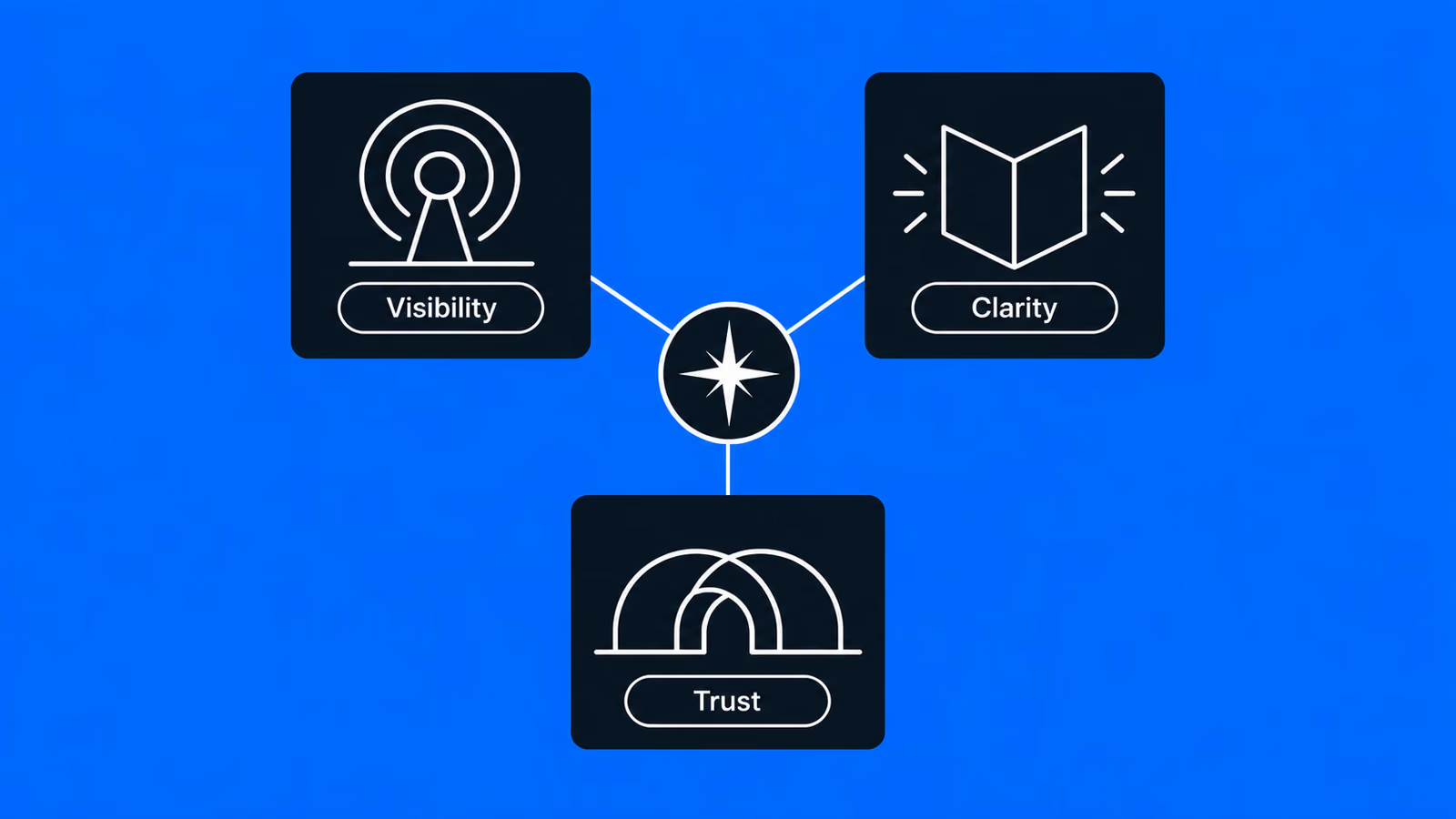
Supasaito’s mission is to change how marketing works and how people perceive it by making Visibility, Clarity and Trust the standard. “Found by AI. Chosen by Humans.” is the north star for the company you want to become: discoverable, clearly understood and chosen with informed confidence. The three principles guide the work toward that ambition.
Why does marketing need a different standard?
When marketing oversells an offering, it creates expectations the business cannot meet. A customer may discover the limitations only after committing. That gap between the promise and the experience is what we want to change.
Our conviction is that misleading expectations contribute to marketing’s reputation as something sneaky or manipulative. We want marketing to earn a different reputation through what it does: give potential customers a clear picture of an offering, support its claims and make relevant options easier to find.
Our mission is to make Visibility, Clarity and Trust the standard for how businesses market and sell. That ambition extends beyond improving individual campaigns. It asks companies to align what they communicate with what they actually deliver.
The principle has established ethical roots. The American Marketing Association’s Statement of Ethics advocates truthful communication, transparency, rejecting manipulation and honoring promises. We want to turn that kind of commitment into everyday marketing decisions.
For business-to-business (B2B) companies, the practical question is simple: can a prospective customer find you, understand whether your offering fits and verify the reasons to believe you?
What does “Found by AI. Chosen by Humans.” mean for your company?
“Found by AI. Chosen by Humans.” describes a position your company can work toward. It means presenting an offering that can be discovered during artificial intelligence (AI) assisted research and that people can evaluate with a clear understanding of its value, limits and evidence.
The slogan is a north star for your business. Visibility, Clarity and Trust are the principles for pursuing it:
- Visibility: make relevant, accurate information discoverable where potential customers look.
- Clarity: explain what you offer, whom it serves and what potential customers should realistically expect.
- Trust: support claims with genuine evidence and fulfill the promises you make.
There is a practical connection between machine discovery and human choice, but it needs careful boundaries. For Google’s AI Overviews and AI Mode, Google’s published guidance says ordinary search engine optimization (SEO) fundamentals remain relevant. Accessible text, internal links and helpful content matter. An indexed page eligible for a Search snippet can qualify as a supporting link; eligibility does not guarantee inclusion. Google requires no special AI files or additional markup for these features.
Google also recommends helpful, reliable, people-first content, with clear sourcing and evidence of expertise. That supports our emphasis on information potential customers can understand and check. It does not establish that every AI system detects honesty or favors the same companies.
People still seek validation. Gartner’s May 2026 release reported that 69% of surveyed B2B purchasers preferred validating AI-generated insights with sales representatives. The survey covered 645 B2B purchasers in August–September 2025. It describes a preference in that sample, rather than the accuracy of AI answers. Read Gartner’s survey findings.
Our aim is to make your company easier to discover and easier to evaluate honestly. No set of principles can guarantee an AI recommendation or a purchase.
Visibility, Clarity and Trust support one another. This conceptual illustration shows the principles together, rather than a fixed buying sequence.
Visibility: can the right people find your offering?
Visibility means making truthful information available in the places potential customers use to research problems, compare options and seek recommendations.
Start with the questions your offering can genuinely answer. Explain the problem, describe the solution in language potential customers recognize and give useful explanations their own accessible pages. Link related information so a reader can move from an initial question to the details needed for a decision.
A visibility problem might look like this: an offering has a clear explanation and credible proof, but those materials are difficult for someone unfamiliar with the company to discover. The next action should address access and discovery while preserving the accuracy of the message.
Review where relevant visitors come from, which questions bring them to your pages and whether those visits lead to suitable inquiries. If you track AI mentions or citations, check the context and the linked source. A mention alone cannot tell you whether the offering was represented accurately.
The goal is relevant discovery. A message that attracts potential customers through an exaggerated promise already conflicts with the other two principles.
Clarity: can people judge whether it fits?
Clarity means explaining enough for a potential customer to make an informed decision, including a decision that your offering is unsuitable.
An offer should answer:
- Who is it for, and what problem does it address?
- What does it include, and what is outside its scope?
- What benefits can a potential customer reasonably expect?
- What conditions or limitations affect those expectations?
- How does pricing work, or what must be clarified before a quote?
- What happens next if the potential customer wants to discuss it?
Recent research on purchasing decisions gives a concrete reason to take these questions seriously. In TrustRadius’s January 2026 survey, 59% of respondents wanted more transparent pricing and 35% wanted clearer buying criteria. Its July 2026 report drew on 1,862 verified technology purchasers from its global network, discussing prior-year purchases. Respondents received an incentive. These findings describe that sample, rather than all B2B purchasers; TrustRadius also sells review services. Read the 2026 B2B Buying Disconnect Report.
Review questions prospects repeatedly ask, misunderstandings about scope and inquiries from people the offering cannot serve. Use them to improve the explanation. A shorter description is useful only if it still gives an accurate picture.
Trust: can people verify your promises?
Trust means giving potential customers credible reasons to believe your claims and matching the delivered experience to those claims.
Use evidence that a reader can evaluate: relevant customer stories with permission, clearly explained results, identifiable expertise and transparent conditions. State the context and limits of an example. Keep evidence current when the underlying offering changes.
A polished testimonial card or badge should represent something real. Presentation cannot replace evidence, and evidence cannot excuse promises the company fails to fulfill.
AI citations need scrutiny too. The citation audit in LiveResearchBench, an ICLR 2026 paper revised in April 2026, found unsupported claims, invalid links and irrelevant sources in reports produced by the named systems it tested: GPT-5, Grok-4 Deep Research and Open Deep Research. Its market-analysis and wide-information-search tasks used an automated citation judge with human-alignment checks. The named versions and earlier experiments limit what it says about other systems or today’s performance. The practical lesson is to check whether a cited source actually supports a claim. See LiveResearchBench, Appendix E.
Review the concerns potential customers raise, the evidence they request and any gaps between sales expectations and delivery. An inquiry is a useful signal, but it does not prove that potential customers trust the company.
Why do the three principles belong together?
Each principle addresses a different customer question. Use this comparison to identify what needs attention.
| Principle | Customer question | A sign to investigate | Practical action |
|---|---|---|---|
| Visibility | Can I find a relevant option? | Useful explanations are hard to discover | Make accurate answers accessible and connect related pages |
| Clarity | Is this suitable for us? | Potential customers misunderstand the offer or its limits | Explain benefits, scope, conditions and unsuitable cases |
| Trust | Why should I believe the claims? | Promises lack checkable support | Provide genuine evidence and align promises with delivery |
Consider these hypothetical situations, rather than customer case studies:
- Visible but unclear: a service attracts attention with a broad promise, while its exclusions are buried. Improve the explanation and set accurate expectations before expanding exposure.
- Clear but unsupported: a product explains its use well, but displays impressive-looking badges without explaining what they verify. Replace unsupported signals with evidence potential customers can inspect.
- Credible but difficult to find: a specialist has useful evidence and a precise offer, but a prospective customer cannot easily locate either. Make those materials discoverable without overstating their meaning.
The principles should shape the same offering and the same message. Discovery, understanding and confidence need to remain connected throughout the prospective customer’s research and the company’s delivery.
Where should your company start?
Choose one important offering and examine it from the perspective of someone encountering your company for the first time.
- Find it. Can a potential customer reach a useful explanation from the places you expect them to research?
- Explain it. Can they identify the problem it addresses and whom it serves?
- Set expectations. Are scope, exclusions, conditions and limitations clear?
- Check fit. Can they recognize a situation where they should choose something else?
- Verify it. Can they inspect the evidence behind the claims?
- Check delivery. Do sales promises match what customers receive?
- Take the next step. Is the contact route clear, with realistic expectations about what follows?
Use the answers to choose a concrete improvement. This is a working checklist, not a validated score. Record the change and review suitable inquiries, customer questions and delivery feedback to understand what happened.
How does Supasaito put this approach into practice?
Supasaito offers a B2B customer acquisition platform that organizes business context, analytics, recommendations and campaign work with people and agents. Our principles guide how we approach that work: what information to make discoverable, what an offering needs to explain and what evidence supports its claims.
Implementation and training, ongoing marketing support and custom development are separately described services. The support you need may involve the platform, services or a combination; the scope should be agreed explicitly.
Changing marketing’s standard requires the same discipline in our own offer. We want prospective customers to understand what they are considering and what needs to be discussed before committing.
If you want to apply Visibility, Clarity and Trust to your business, describe your situation through our English Contact Sales form. Tell us what you offer, whom you serve and where potential customers struggle to find, understand or evaluate it. Submitting an inquiry starts the conversation; booking a sales call is a separate next step.
Frequently asked questions
- Is this only about AI search?
-
Visibility includes AI-assisted research, search and other channels where potential customers look for answers. Clarity and Trust apply to the offering wherever people encounter it, and to whether delivery matches the promises made.
- Does clear, trustworthy content guarantee AI recommendations?
-
No. Google’s guidance explains eligibility and relevant SEO fundamentals for its AI features, without guaranteeing inclusion. Other systems may behave differently. “Found by AI. Chosen by Humans.” expresses the position a company works toward.
- Does honest marketing mean avoiding persuasion?
-
Our approach asks companies to persuade through a clear explanation of value and credible reasons to believe it. Explain why your offering is suitable while making its limits and unsuitable cases visible.
- Do we need to redesign our website first?
-
Start by identifying the actual gap. It might be discovery, an unclear offer or weak evidence. Use that diagnosis to decide what work is needed before choosing a redesign or another intervention.
- Can Supasaito help with both the platform and implementation?
-
Supasaito offers its platform alongside separately scoped implementation and training, marketing support and custom development services. Use the Contact Sales form to discuss your situation and the support you need.
- What is the company mission behind these principles?
-
Our mission is to change how marketing works and how people perceive it by making Visibility, Clarity and Trust the standard. We want potential customers to discover relevant offerings, understand them accurately and choose with confidence grounded in evidence and promises fulfilled.