Do more AI mentions mean more customers?
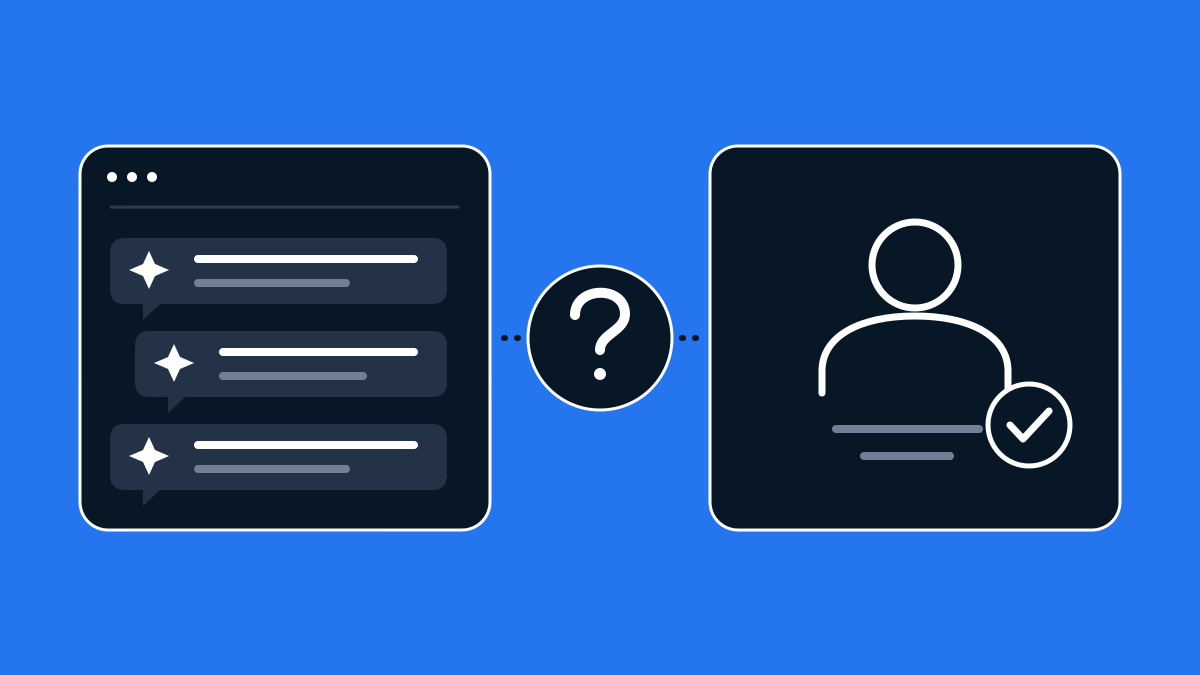
More mentions in AI answers show that your brand appeared more often in the answers you measured. They do not tell you whether more people visited your website, contacted your team or became customers. To answer the business question, you need records of those outcomes as well.
Imagine a report showing that your brand appeared in 6 of 20 AI answers in one round and 12 of 20 in another. The share doubled. Before describing that as customer growth, ask a more concrete question: where is the record of the customers?
The useful next step is to connect the question to the right evidence, while keeping each measurement’s meaning clear.
Start with what the mention count actually tells you
For this fictional example, assume both rounds used the same questions and counting rule, with comparable collection conditions. Count each completed answer containing the brand once, even if it names the brand several times.
The brand appeared in 30% of completed answers in the first round and 60% in the second. That is an increase of 30 percentage points, and twice the initial proportion. It describes the collected answers. It is not a count of people who saw them.
In a real comparison, save the questions and answers, collection dates, language, AI provider, search mode and model where known. Record failed or unavailable answers separately. Our guide to measuring AI visibility explains how these conditions affect the comparison.
Now separate the questions that follow. Did someone reach the website? Did the company receive an enquiry? Did the team confirm a relevant sales opportunity? Did that opportunity become a customer? Each requires different evidence.
Keep a separate record for each outcome
Use a reporting sheet with a row for each observation. The following table shows where to look and what to check. It is a suggested reporting method, not a claim that every potential customer follows these steps in order.
| Question | Where to look | What to record |
|---|---|---|
| Did the brand appear in the measured answers? | Saved AI answers | Answers containing the brand, total completed answers and collection conditions |
| Were website visits recorded from an identifiable AI source? | Website analytics | Recorded visits, source information, dates and the unit counted, such as sessions |
| Did someone contact the company? | Received enquiries | The actual message and date; keep repeated messages in the same conversation together |
| Is there a relevant sales opportunity? | The sales team’s assessment | The stated need, the team’s qualification decision and its reason |
| Did the opportunity become a customer? | The company’s sales records | The agreed customer definition and evidence that it was met |
For example, a message asking about a service establishes that an enquiry was received. It does not establish that the request fits the offer, that a sale was agreed or that payment was received. Record the stage the team has actually confirmed.
In the sales record, an entry such as “Enquiry received; qualification pending” is more useful than labelling the sender a customer. Keep a reference to the original message beside it so the next person can check the status.
Read an analytics event before calling it a lead
In Google Analytics 4 (GA4), an event records an action. A key event is an event marked as important to the business. Google’s documentation explains that any collected event can be designated a key event, including a scroll.
The label therefore does not tell you whether the event represents an enquiry or a sale. A scroll marked as important remains a recorded scroll.
Before using a key-event total in a commercial report, check its definition. In the reporting sheet, write what triggers it: for example, “Page scroll; not an enquiry”. If an event is intended to represent a received enquiry, check it against the actual enquiry records before reporting qualified opportunities. Qualification requires the team’s assessment; a confirmed customer requires the corresponding sales evidence.
This lets the report distinguish an action recorded by analytics from a commercial outcome confirmed by the business.
Keep known referrals and unknown sources separate
AI search can lead to website visits. Google Search Central states that traffic from AI Overviews and AI Mode is included in Search Console’s overall Web search reporting. Those combined figures do not isolate all visits from AI features.
Website analytics can also lack clear source information. Google describes direct traffic as traffic without a clear referral source. A direct visit is therefore not evidence that AI sent the visitor.
In the reporting sheet, keep visits with an identifiable AI source separate from visits whose source is unknown. Record the report, date range and source filter used. Do not add direct traffic to the AI total because the visits seem likely to have come from an assistant.
A potential customer could also read an AI answer and contact the company later by another route. That is a possibility to investigate, not a reason to assign an unknown source to AI. Missing attribution leaves a gap in the evidence.
Put the known result beside the missing evidence
Return to the fictional 6-of-20 and 12-of-20 example. No visit, enquiry or customer records have been supplied. The report should show that directly:
| Observation | First round or period | Second round or period |
|---|---|---|
| Brand-containing AI answers | 6 of 20 completed answers; 30% | 12 of 20 completed answers; 60% |
| Recorded visits from identifiable AI sources | Not supplied | Not supplied |
| Received enquiries | Not supplied | Not supplied |
| Qualified sales opportunities | Not supplied | Not supplied |
| Confirmed new customers | Not supplied | Not supplied |
All figures are illustrative. Comparable answer collection is assumed for the example; actual dates and business observation periods are not supplied. “Not supplied” means unknown, not zero.
Do not divide customer or enquiry totals by the 20 AI answers to calculate a conversion rate. These answer samples are not a group of people whose progress you followed. Even separately available visit and enquiry totals need matching definitions, periods and records before they can describe a conversion between stages.
For a real report, put the start and end dates, timezone, source and counting rule beside each row. For each enquiry, record when it arrived and whether it had become a confirmed customer by the report’s closing date. If discussions were still ongoing on that date, mark the opportunity as open rather than counting it as a customer or a lost sale.
Choose the next check from the question you need to answer
If the question is “Did we gain more customers?”, ask for the new-customer records for the comparison periods and confirm how a new customer is defined. More answer samples will not fill that particular gap.
If the question is “Did those customers come through AI?”, examine the available source evidence alongside their enquiry and sales records. If the question is “Did our AI work cause the increase?”, seeing both figures rise is insufficient: you also need evidence that distinguishes its contribution from other explanations.
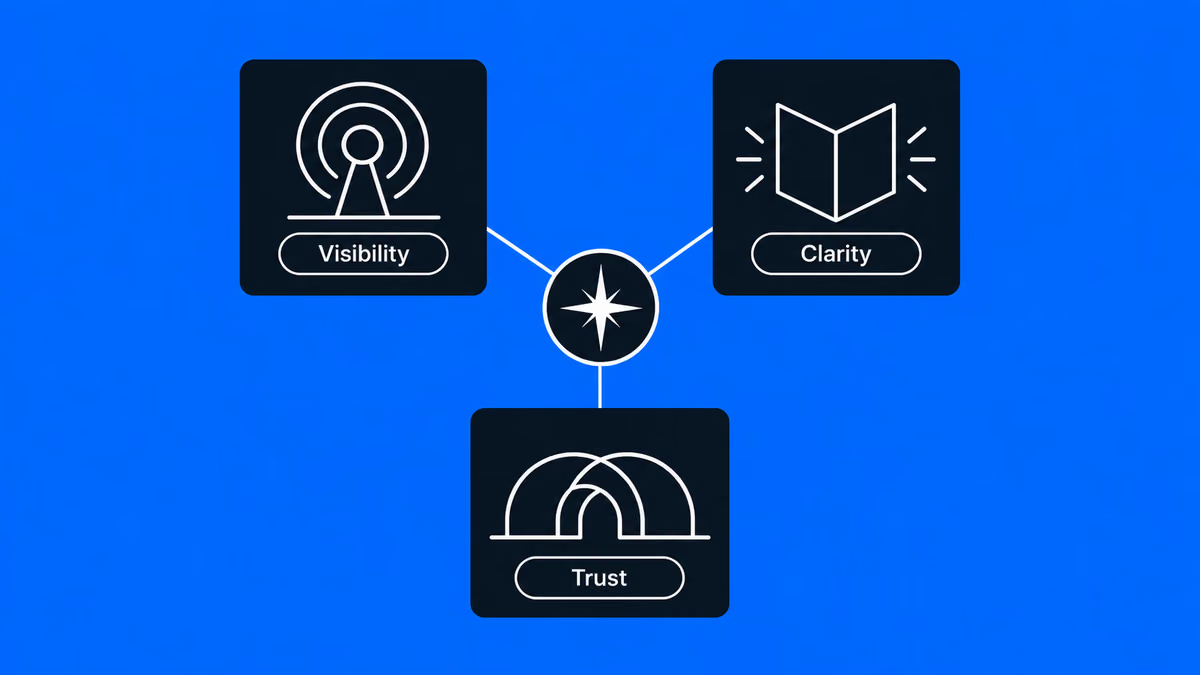
Our guide to executive reporting provides the wider reporting context. For the relationship between discovery, understanding an offer and choosing a company, see Visibility, Clarity and Trust.
For the example above, a defensible reporting note is: “The brand appeared in a larger share of the measured AI answers. Customer change is unknown because customer records have not been supplied. Next, obtain those records for defined comparison periods.”
That gives the team a clear action and preserves what the visibility result actually established.