8 Best LLMO / AI Search Optimization Agencies in Japan (2026)
“Who do we hire to fix our AI-search visibility in Japan?”
If you are asking that in English, you are probably asking it from outside the market: a brand launching in Japan, or already selling there and finding that ChatGPT and Google’s AI Overviews recommend Japanese competitors you had never heard of. From outside, the candidates are hard to tell apart — a wall of logos, pricing on request, and most of the evidence in a language you may not read.
That is who this article is written for. If you are a Japanese company, the Japanese edition covers the same ground for you.
It compares eight LLMO (AI search optimization) firms operating in Japan, on public information, and leads with the selection criteria rather than the shelf. There is also a section the Japanese edition does not need — what actually changes when the market is Japan — because that is the part a vendor from your own country cannot do for you, and the part worth testing an agency on.
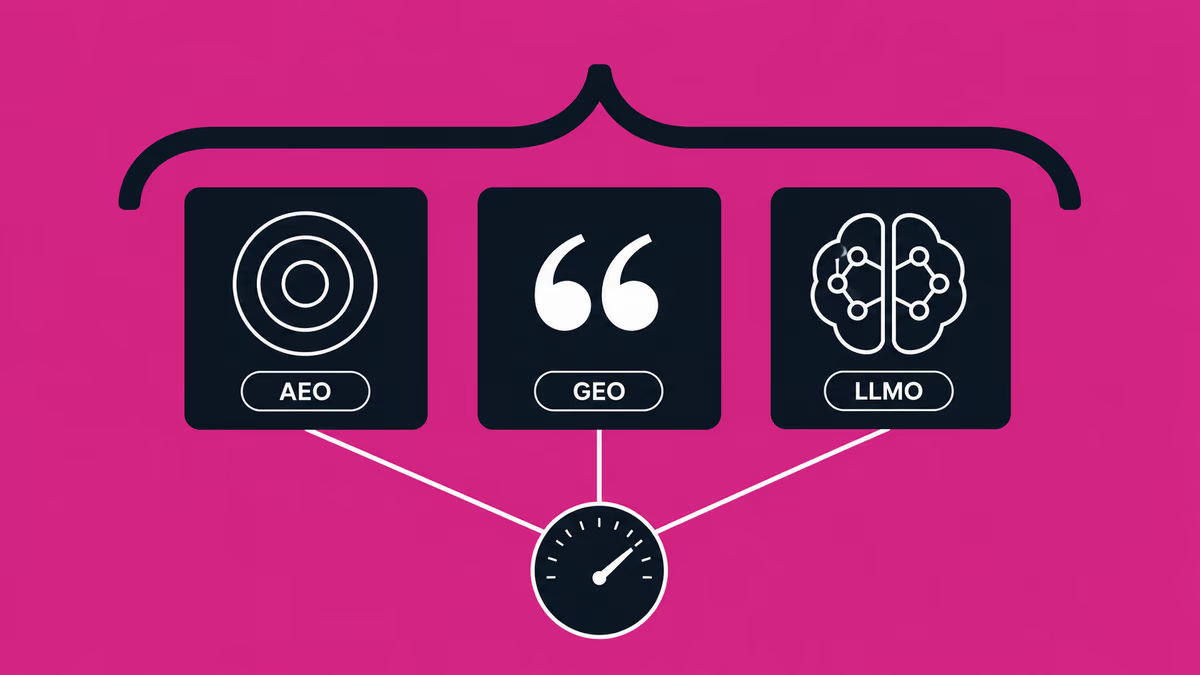
For the terminology (how AEO, GEO and LLMO differ), see our AIO glossary. For pricing benchmarks, see How Much Does LLMO Cost in Japan? (2026).
A disclosure up front. This list was compiled by Supasaito. We offer LLMO services ourselves, so we’ve included our own entry as one candidate, judged by the same criteria. Placement here is unpaid — no advertising or PR slots buy position.
The short answer: the one question to ask first
Before the detailed comparison, the single most important lens:
“Who ships the fixes after the report?”
Most LLMO improvement is changes to the site itself — structured data, primary-source content, external signals. However precise a visibility report is, the number won’t move until someone implements it. Measurement is increasingly automated by tools, so what’s actually worth paying for is the judgment to read the data and the implementation to act on it. Compare vendors on that axis.
How to choose an LLMO agency: 5 criteria
Before you trust any “best-of” list, bring your own yardstick. Here are the five criteria we use to evaluate an agency.
- Measurement methodology — which AI engines, how many prompts (buyer questions), and against which competitors? Check whether they cover multiple engines (ChatGPT, Claude, Gemini, Google AI Overviews) and measure continuously, not with one-off screenshots.
- Implementation capability — the question above. Does it stop at recommendations (a report), or do they ship changes to your site? And do they hand the capability back so your team can run it themselves?
- Pricing transparency — do they publish at least a floor, or is it “contact us” only? Private pricing is fine, but you need to be able to quote on aligned assumptions (engines, prompt count, implementation-or-not).
- Enterprise / industry track record — do they have experience at your scale and in your sector? This matters most in accuracy-critical fields (medical, finance).
- Native-language analysis — AI answers behave differently by language. Can they analyze in your market’s search context and competitors? Add multilingual coverage if you’re expanding abroad.
Weight these five by your own priorities and the list of logos narrows fast.
What changes when the market is Japan
Three things behave differently here. They decide whether an engagement works, and they are the questions to put to any candidate below — including us.
1. The sources AI cites are domestic, and they are not the ones you know. An AI answer is assembled from what it can find and trust. In our own category we measure that continuously: in the scan of 31 August 2026 — 9,643 citations across 2,208 answers from ChatGPT, Claude, Gemini and Google AI Overviews — the most-cited non-competitor sources were PR TIMES (the Japanese press-release wire), note.com (Japan’s publishing platform), ASPIC (the cloud-industry association’s directory) and ITreview and IT Trend (the domestic B2B software review sites). No G2, no Capterra, no Reddit, no Product Hunt.
That is one category, not the whole market, and your own will differ — but the shape holds: the surfaces that decide your visibility in Japan are mostly Japanese, mostly ones a foreign team has no account on, and several of them are not open to self-service. Ask a candidate which sources they have measured for your category, and what they can actually do about them.
2. Your brand name is written several ways, and a measurement that misses one is wrong. A foreign brand in Japan appears in katakana, in the Latin alphabet, sometimes in kanji, in full-width and half-width characters, with and without the corporate suffix — often several of these in one answer. If a tool treats those as different entities, your visibility number is understated and you cannot tell by how much. This is 表記ゆれ (hyōki-yure, spelling variation), and it is the single most common way an AI-visibility report about a foreign brand in Japan is quietly wrong. Ask how variants are matched, and ask to see the list.
3. Translated content does not get cited; written content does. Japanese readers recognise 直訳調 — translationese — immediately, and so, increasingly, do the models summarising it. A page rendered out of English tends to be passed over in favour of one written natively, even when the facts are identical. This is the most expensive of the three to get right, because it is not a tooling problem: it is a writer, in Japanese, who understands your product. Ask who writes, in what language, and whether the deliverable is a translation or a draft.
None of the three is visible from a dashboard in your own market, which is why “we support Japanese” and “we can work in Japan” are not the same claim.
The 8 agencies compared
Using the criteria above, here are seven firms we could verify from public information, plus us — organized by type, not rank (fit decides the outcome, so we don’t rank 1→8).
| Agency | Type | Pricing transparency | Implementation | Key strength |
|---|---|---|---|---|
| PLAN-B | Full-service digital marketing | Private (on request) | Yes | Integrated marketing × data-driven |
| Speee | Full-service SEO / AEO | Private | Yes | AI research org · proprietary score · 3,000+ clients |
| Nyle | Full-service SEO | Private | Yes | 2,000+ clients · CVR focus · listed company |
| WILLGATE | Full-service SEO | Private | Yes | 8,000+ clients · “named-citation” focus |
| ipe (AKARUMI) | Tool × consulting | Partial (free tool trial) | Partial–Yes | GEO/LLMO analytics tool |
| Faber Company (MIERUCA GEO) | Tool × consulting | Private (publishes market-rate guides) | Yes | Measurement tool × data-led fixes |
| MediaReach (DolphinX AIO) | Tool × consulting | Partial (tool ¥30–100K/mo published) | Yes | Japanese-built · daily measurement · MCP |
| Supasaito (us) | Implementation-included · bilingual | Published (free audit / ¥500K+/mo) | Yes (optional) | Bilingual (JP/EN) analysis |
One paragraph on each below.
Full-service SEO / digital marketing (strategy through implementation)
PLAN-B — a large integrated digital-marketing firm spanning SEO, advertising and web production, strong on data-driven operations, with its own LLMO consulting. Pricing is by quote (private). Best fit for mid-to-large companies that want many channels under one roof.
Speee — runs an in-house “AI Research & Innovation Center (AIRI)” and measures ChatGPT/Gemini recommendation status with a proprietary visibility score in its AEO/LLMO consulting. With 3,000+ SEO/AEO clients, it suits companies that want the full strategy → implementation → verification loop.
Nyle — a long-established SEO firm (listed on the TSE Growth market) with 2,000+ clients. Its LLMO consulting covers structured data, FAQ optimization and citation-source authority, and extends to improving conversion after AI-driven visits. Good when you want technology and outcomes under one contract.
WILLGATE — building on 8,000+ SEO engagements, its LLMO consulting is focused specifically on earning “named citations” in AI search, with end-to-end support across Google AI Overviews, ChatGPT and others (its own survey found ~90% of companies worry about not appearing in AI even when they rank in search). Strong on content production at scale.
Tool × consulting (measurement-first)
ipe (AKARUMI) — centers on AKARUMI, a GEO/LLMO analytics tool that surfaces brand recognition inside generative AI, AI Overviews exposure, and citation-source patterns, with data-led LLMO consulting alongside it (500+ SEO/LLMO clients). The tool offers a full-feature free trial, so it fits teams that want to measure for themselves before engaging.
Faber Company — known for the “MIERUCA” SEO tool, it offers the “MIERUCA GEO” AI-search analytics tool (free trial available) plus GEO consulting. Its own consulting is quote-based, but it stands out for transparency by publishing detailed market-rate guides. A fit for data-first, continuous-improvement engagements.
MediaReach (DolphinX AIO) — Osaka-based. Built around DolphinX AIO, a Japanese-built AIO (LLMO/GEO) measurement tool, with SEO and LLMO consulting and GA4 implementation support alongside it. It measures ChatGPT, Gemini, Google AI Mode and Copilot daily (Claude and Perplexity as add-ons), and exposes the data over MCP, so you can query it from ChatGPT or Claude directly. Pricing is published — ¥30,000–¥100,000/month excluding tax — which suits a team that wants a cost anchor before it starts comparing.
Implementation-included · bilingual
Supasaito (us) — our stance is consulting-first. We start with the free AI Visibility Audit: current visibility, competitor analysis and a prioritized list of what to fix first, across ChatGPT and Google AI Overviews. From there we hand the improvements over as instructions your team or existing vendor can ship as-is, with our own implementation available as an option (AIO Program: from ¥500,000/month). Our monthly reports run on Supasaito, a visibility-measurement platform we co-developed. We can analyze in either Japanese or English search contexts.
How we think about it
Line the eight up and you’ll notice their strengths don’t overlap — breadth, tooling, implementation, language coverage. That’s exactly why deciding your own priorities (the five criteria) first is the heart of choosing well.
What we care about most is answering the opening question head-on: who ships the fixes after the report? Visibility numbers only move once the site changes; a report with no implementation path dies in a drawer. That’s also why we publish our floor pricing and recommend starting with our free audit rather than an immediate retainer.
The best first step is simply to measure where you stand (how to measure AI visibility). If you want to see exactly what we cover, that is on our LLMO service page.
One last thing: this article answers who to hire. Which tool to use is a different question, and it is worked through separately in a 14-point comparison of nine AI-visibility tools. Read it knowing it is written by one of the nine — which that piece discloses in its opening paragraph.
Get your free AI visibility audit →
FAQ
How do I choose an LLMO agency?
Evaluate on five criteria: (1) measurement methodology — which engines, how many prompts; (2) whether it stops at a report or includes implementation; (3) pricing transparency; (4) track record in a sector and scale like yours; and (5) native-language analysis. The most important is (2): ask “who ships the fixes after the report?” up front, because most improvement is changes to the site itself and nothing moves without an implementer.
How much do LLMO agencies cost?
On 2026 public data, a one-off diagnostic runs ¥100,000–500,000, monthly consulting sits at ¥150,000–800,000 (full consulting can exceed ¥3M/month), and a full program with implementation is ¥500,000–1,000,000+ per month. Many firms are “contact us” only, so get comparable quotes by aligning engines, prompt count and whether implementation is included. See How Much Does LLMO Cost in Japan? (2026) for the full breakdown.
What parts of LLMO can we do in-house?
Plenty — structuring data and FAQs, publishing primary-source content, and keeping your brand facts consistent are all doable internally. What to outsource is the judgment-heavy work: root-cause analysis of why competitors are being recommended, prioritizing the fixes, and technical implementation. We support teams with self-sufficiency in mind, handing the in-house-doable parts back to you. For the specific in-house steps and where to draw the outsourcing line, see The Complete LLMO Playbook.
So which agency is best?
There’s no universal “number one.” If you want everything under one roof, the full-service firms (PLAN-B, Speee, Nyle, WILLGATE); if you’d rather measure first, the tool-led options (AKARUMI, MIERUCA GEO); if you want published pricing, implementation included, and bilingual (JP/EN) analysis, us (Supasaito). Choose by your own priority criteria — and if in doubt, start with a one-off diagnostic to see where you stand.