What Is AIO (AI Optimization)? Scope, AEO/GEO/LLMO and What It Costs in 2026
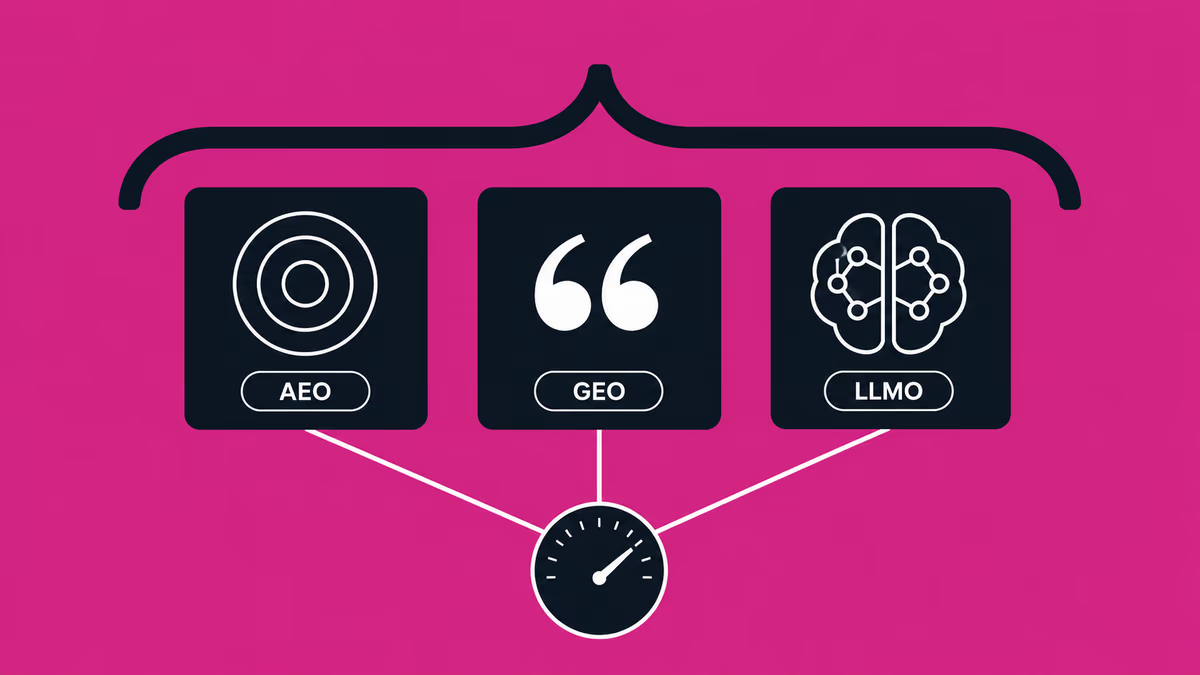
AIO (AI Optimization) is the umbrella term for getting your brand represented correctly, favourably and often across every AI surface — ChatGPT, Gemini, Google AI Overviews and the rest. It is not a single technique: it is the bracket around three disciplines, AEO, GEO and LLMO. On cost, the 2026 published data clusters around ¥100,000–500,000 for a one-off diagnostic, ¥150,000–800,000 per month for ongoing consulting, and ¥500,000–1,000,000+ per month once implementation is included.
“AIO, AEO, GEO, LLMO — the vocabulary keeps growing; what do we actually do first?” This guide sets out what the umbrella covers, how the three disciplines divide the work, the order to run them in, and what the market charges — from the perspective of a team that measures and fixes AI visibility for a living.
The short version: AIO brackets every AI surface
- AIO is a category, not a tactic. There is no discrete “AIO technique”; the word gathers up optimization work aimed at AI surfaces. In buying conversations, “AIO” and “AI search optimization” are used interchangeably.
- Three disciplines sit inside it: AEO (being chosen as the answer), GEO (being cited inside a generated answer), and LLMO (shaping what the models know about you). SEO is the foundation under all three.
- They all point at one number: AI visibility — your share of recommendations against named competitors.
- Cost bands: ¥100,000–500,000 one-off diagnostic, ¥150,000–800,000/month consulting, ¥500,000–1,000,000+/month with implementation (the breakdown by engagement type is in our LLMO / AIO pricing guide).
The first step is not picking which acronym to buy. It is measuring how AI treats you today, because where you stand decides which of the three disciplines deserves the budget.
Why an umbrella term appeared at all
The vocabulary grew in pieces. “GEO” comes from a 2023 research paper, GEO: Generative Engine Optimization (Aggarwal et al., KDD 2024); “LLMO” and “AEO” came out of marketing practice.
The problem for buyers was that the three terms describe largely the same work. What makes an AI pick you — trustworthy first-hand information, machine-readable structure, third-party corroboration — does not change between them. “AIO” appeared to name the whole thing at once.
So “should we buy GEO or LLMO?” is rarely the right question. In practice it is one continuous programme.
How the three divide the work
| Discipline | Full name | Aim | Typical time to move |
|---|---|---|---|
| AEO | Answer Engine Optimization | Being chosen as the answer in AI Overviews and featured snippets | Fast (1–3 months) |
| GEO | Generative Engine Optimization | Being cited inside the generated answer | Medium (3–6 months) |
| LLMO | Large Language Model Optimization | Making the models understand and remember you correctly | Long (6–12 months) |
All three vary with your industry and competitors. Strict definitions are laid out in our AIO terminology guide.
The important thing about that table is that it is not a running order. The three build in parallel. What differs is how quickly each shows up in the numbers — so AEO work tends to give early feedback while LLMO needs patience.
How AIO work actually runs
Sequencing by practice beats sequencing by acronym.
- Diagnose. Put your category’s likely questions to the major engines and record who is recommended and why. Skip this and you spend budget on fixes that do not apply to you.
- Answer-first structure. Lead each section with its conclusion, phrase headings as questions, carry an FAQ. You are making it easy for a model to lift a quotable passage (this feeds AEO and GEO).
- First-hand information. State your own data, numbers, prices and results without hedging. Models cite what is not a rewrite of someone else.
- Structured data and machine readability. FAQPage schema, a clean heading hierarchy,
llms.txt. Speed and accessibility count too — they decide whether a model can read the site at all. - External signals. Consistent company facts, press coverage, reviews. Model memory (LLMO) does not move on your own site alone.
- Measure continuously. Track share of recommendations and let it choose the next move.
A great deal of this is in-house work; we broke it into twelve concrete items in How to do LLMO (12 things you can do yourself), and the measurement design itself in How to measure AI visibility.
What AIO costs in 2026
Price follows the engagement type, not the acronym.
| Engagement | Typical range | Usually includes |
|---|---|---|
| One-off diagnostic | ¥100,000–500,000 (once) | Current visibility, competitor comparison, direction |
| Monthly consulting | ¥150,000–800,000 / month | Strategy, recommendations, monthly measurement. Usually excludes implementation |
| Full programme with implementation | ¥500,000–1,000,000+ / month | The above plus content and technical work |
| Enterprise | Several million yen | Cross-team, multi-brand, high query volume |
Speee’s cost breakdown puts diagnostics from about ¥300,000, monthly consulting at ¥150,000–3,000,000+, and implementation support at ¥300,000–1,000,000+; Faber Company (mieru-ca) gives near-identical bands. Plenty of firms do not publish at all — PLAN-B’s LLMO consulting is listed as price-on-request even on comparison sites. The full breakdown, and what you should expect to receive at each price point, is in our LLMO / AIO pricing guide.
Before you compare numbers, level the assumptions: which engines, how many prompts, and report-only or implementation included. Get those wrong and two quotes for “AIO” can differ several-fold for good reason.
How we think about it
Our position does not move: the money is worth spending on judgement and implementation, not on measurement. Visibility numbers only move when the site changes. A report nobody implements sits in a drawer.
So we publish the floor and quote the rest by scope.
- AI Visibility Audit: free — current visibility across ChatGPT and Google AI Overviews, competitor analysis, and a priority-ordered list of fixes. A single snapshot; it does not include trends.
- AIO Program: from ¥500,000 / month — continuous implementation plus a monthly report showing your share of recommendations against competitors.
Recommendations arrive as implementation-ready specs your team or your existing agency can ship as-is. Where a one-off study normally costs ¥100,000–500,000, ours is free. The whole picture is on our AIO page, and the rates on our pricing page.
Get your free AI visibility audit →
FAQ
What is AIO?
AIO (AI Optimization) is the umbrella term for making sure your brand is represented correctly, favourably and often across AI surfaces such as ChatGPT, Gemini and Google AI Overviews. It is not one technique — it brackets three disciplines: AEO (being chosen as the answer), GEO (being cited inside a generated answer) and LLMO (shaping what the models know about you).
What does AIO cost?
On 2026 published data, a one-off diagnostic runs ¥100,000–500,000, monthly consulting ¥150,000–800,000, and a full programme including implementation ¥500,000–1,000,000+ per month. Enterprise engagements reach several million yen. Because scope (engine count, prompt count, implementation) can swing the number several-fold, compare quotes only on matched assumptions. The breakdown is in our pricing guide.
Which of AEO, GEO and LLMO should we buy?
In practice the distinction matters less than vendors imply, because most of the underlying work overlaps. If you need visibility in AI Overviews soon, AEO leads; if you want to be cited inside generated answers, GEO; if the models state wrong facts about you, LLMO.
If we already do SEO, do we still need AIO?
Yes. The two overlap on good content and structured data, but AIO targets appearing inside the answer, which is a different KPI and a different set of moves. Ranking well while being absent from AI answers is a common and specific failure. A diagnostic is the efficient way to see how far your existing SEO carries into AI search.
How long before it shows results?
It depends on the discipline. As a guide: fast surfaces such as AEO and AI Overviews in 1–3 months, meaningful movement in share of recommendations in 3–6 months, durable model recognition in 6–12 months. All of it varies with industry and competition, so treat any “guaranteed X% in Y weeks” claim as something to interrogate.