How To Do LLMO in 2026: Where To Start, and 12 Steps You Can Do In-House
“We want to start on LLMO (AI search optimization) — but how much of it can we actually do ourselves first?” It’s one of the most common questions we get from marketing and web leads who are just getting into it. Wanting to move the parts you can move yourself before you outsource anything is exactly the right instinct — and in fact, most of LLMO is something you can start on without any special tools.
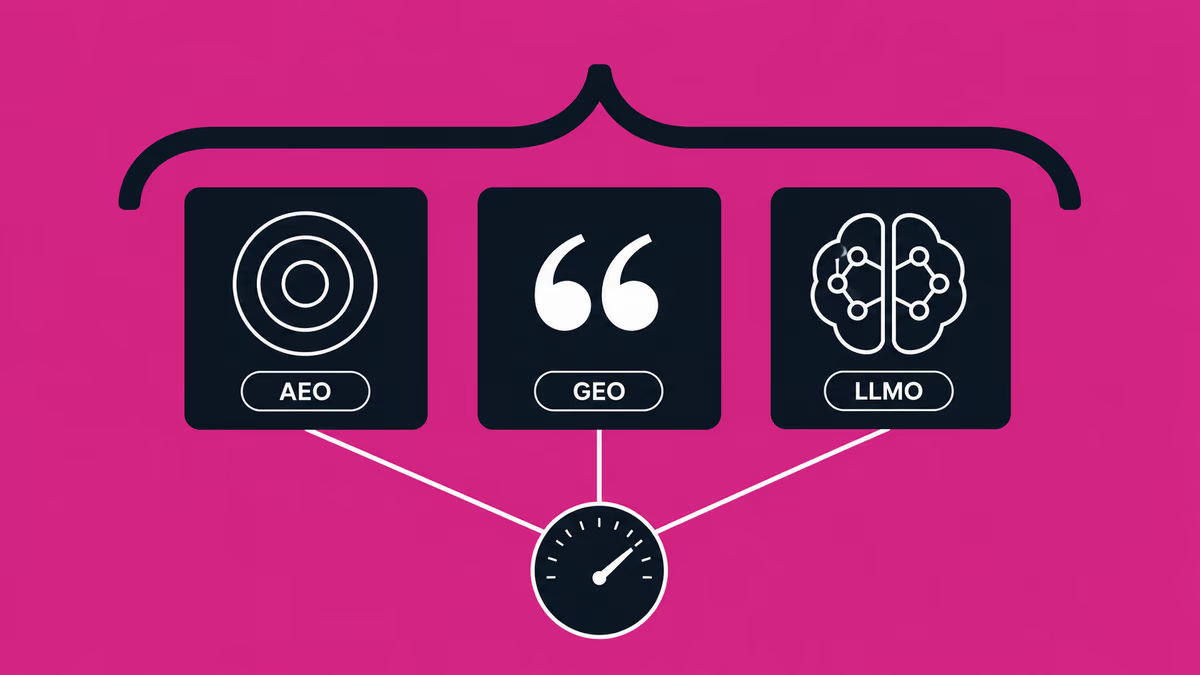
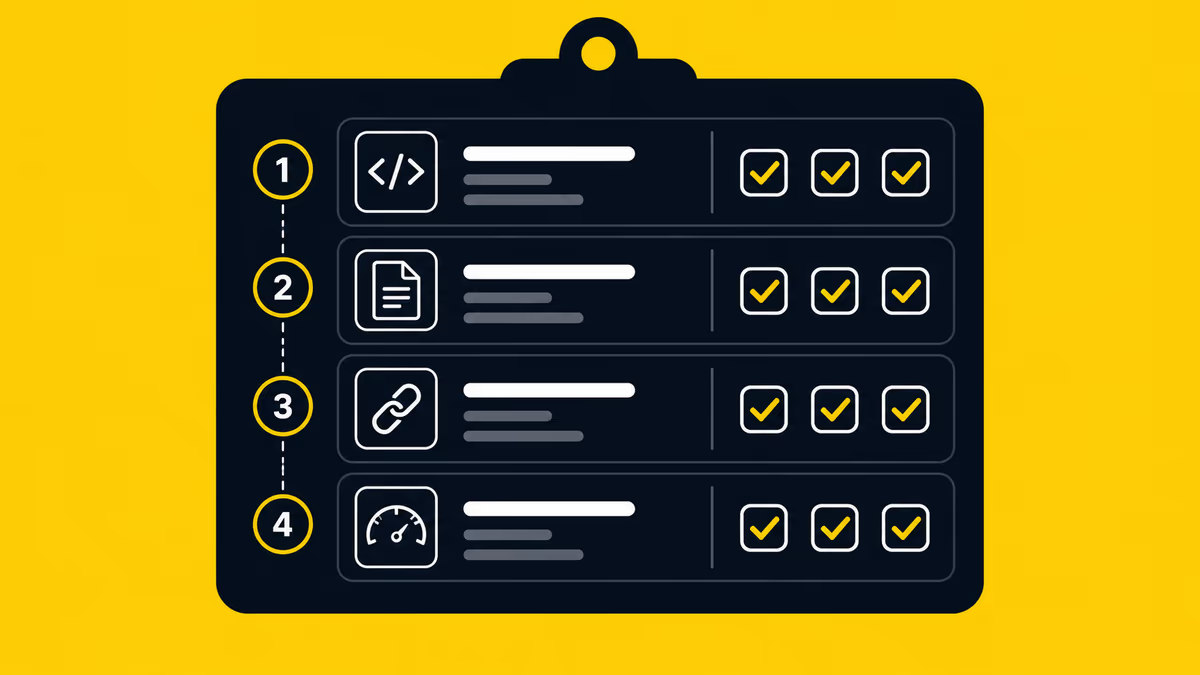
This article breaks the LLMO work we do day-to-day into four layers — structure, content, off-site signals, and measurement — as 12 concrete steps you can run in-house. It also draws an honest line between what a team can genuinely do alone and where specialist judgment and implementation start. For the terminology (how AEO, GEO and LLMO differ), see our AIO glossary.
The short answer: most of LLMO is in-house work. The hard part is priority
Here’s the point up front. Most individual LLMO tactics are things your own team can execute. Adding structured data, publishing primary information, gathering reviews — none of it is magic. What’s genuinely worth paying an outside team for isn’t the tactics themselves — it’s the judgment of which 3 of the 12 steps matter for your case, and the implementation work that’s technically hard.
That’s why we’d rather hand a team the 12 steps and help them find the ones that move the number than hoard them and bill for execution. For most companies, that’s the better value. So let’s start by sharing the 12 steps in full.
How to start with LLMO: the first 5 steps
Before the full list, here’s what to do first, and in what order — because most teams stumble on sequence, not on the tactics themselves. These five steps are the no-detours way to get going.
- Measure where you stand (diagnose). Put your category’s likely questions to ChatGPT, Gemini and the others, and record who gets recommended today, and why. Skip this and you’ll spend time on tactics that don’t move your case (detail in step #10 below).
- Lock down your entity facts. Make your legal name, what you do, location and core services explicit on your official site (#6) — the base the AI needs to identify you uniquely.
- Get your answer pages in shape. Build answer-first pages and FAQs for the questions customers ask (#2, #5) — this is where you create the substance worth citing.
- Grow outside corroboration. Third-party coverage, honest reviews, and consistent brand facts (#7–#9). The biggest driver of AI citations actually sits off your own site.
- Measure monthly and pick the next move. Track share of voice across the four major engines (#10–#12) — on a monthly cadence, not after every change.
These five run in order: doing step 1 (diagnosis) first is what lets you narrow steps 2–4 to the three that matter for you. Each step’s concrete work is covered one by one in the 12 steps below.
12 LLMO steps you can do in-house (organized in 4 layers)
Below are the 12 practical steps, grouped by the four layers we use on client engagements — structure, content, off-site signals, and measurement. Each carries an effort level (low / medium / high) — a rough gauge of the time and specialist skill it takes.
Structure: get it into a form the AI can read (3 steps)
1. Implement structured data (JSON-LD) — effort: medium
Describe your company, products and Q&As in machine-readable form with Organization, FAQPage and Article schema in JSON-LD. Structured data helps the AI understand your content correctly even when no rich result is shown. The golden rule is to match what’s actually visible on the page — markup that differs from the real content gets ignored, or backfires.
2. Write “answer-first” headings and copy — effort: low-to-medium
A logical heading hierarchy (H2/H3), a Q&A format that states the conclusion before the detail, and concise summaries. AI lifts “the answer part” out of longer text to cite it, so putting the answer up front makes you more citable.
3. Add an llms.txt — effort: low
llms.txt is a proposed spec that summarizes your site and its key pages in a machine-readable form for AI. It’s cheap to add, and we ship it on the sites we support ourselves. But an honest caveat: no major search or answer engine has publicly committed to using it in production, and Google stated in 2025 that it doesn’t officially support llms.txt. Adoption sits at around 10%, and the same study found no relationship between having the file and how often a domain gets cited in AI answers (SE Ranking, ~300,000 domains). For now it’s best treated as a low-priority “won’t hurt, won’t lift visibility on its own” measure.
Content: create the substance worth citing (3 steps)
4. Publish primary information — effort: high
Case studies, proprietary data, genuine expert explanations — the things only you can provide. AI favors brands it has a reason to cite. Rather than repeating what others say, grow the pages that answer your customers’ real questions with primary information. This is the foundation of LLMO.
5. Build pages that directly answer customer questions — effort: medium
“Which companies do you recommend for [category]?” “What’s the difference between [you] and [competitor]?” — map out the questions your customers put to AI, and build a page-level answer for each. Comparisons, FAQs, ballpark pricing — content that meets pre-purchase questions head-on gets cited more.
6. State your entity facts explicitly — effort: low
Legal name, what you do, location, founding year, core services — put the basics that make your company and products uniquely identifiable clearly on an about page. When a brand name is ambiguous, AI avoids mentioning it, so this unglamorous step punches above its weight.
Off-site signals: build corroboration beyond your own site (3 steps)
7. Grow mentions in third-party media and comparison articles — effort: high
The most overlooked layer, and the most effective. In an AirOps study of 21,311 brand mentions, brands cited on commercial-intent queries were 6.5× more likely to be sourced from third-party content than from their own domain — and roughly 90% of those third-party citations came from listicles, comparison pieces and review sites (AirOps: The Influence of Offsite Signals in AI Search, 2025). Grow external mentions honestly, through coverage, interviews and contributed pieces.
8. Gather reviews honestly — effort: medium
Customer voices and reviews act as third-party corroboration. But fake or planted reviews are off-limits — they badly damage trust if found out, and AI doesn’t weight inconsistent praise. Build up fact-based reviews through legitimate requests.
9. Make your brand facts consistent across every channel — effort: low-to-medium
If your company name, address and business description differ across your official site, social profiles, directories and external media, the AI can’t form a correct picture. Standardize the details and update stale records — it sharpens how identifiable you are.
Measurement: check where you stand every month (3 steps)
10. Build a prompt panel and check the four major engines monthly — effort: medium
Draw up a list of the questions (prompts) customers might ask about you and your competitors, and check them regularly across ChatGPT, Claude, Gemini and Google AI Overviews. Answers differ by engine, so always look across more than one. This measurement — and even a first pass at what to improve — is something tools can automate: Supasaito, which we co-develop, both tracks your visibility and generates improvement suggestions. Our honest view, though, is that automated suggestions are a strong starting point, not a substitute for an expert reading your specific competitive situation and deciding what to prioritize. A tool shows you where you stand and points at possibilities; judging why competitors get recommended, and what to fix first for your case, is still a separate job.
11. Record share of voice vs. competitors, and the sources — effort: medium
Don’t just log “were we mentioned.” Record your recommendation share against named competitors (share of voice), the ordering, and the sources the AI cited — so that when a number moves, you can trace why. For how to measure these five axes in detail, see How to Measure AI Visibility.
12. Don’t measure after every change (look monthly) — effort: low
Measuring after every single tweak means chasing sampling noise. AI takes time to reflect changes, so reading the numbers on a fixed cadence — monthly, say — is the practical approach.
What you can do in-house, and what to outsource (an honest line)
We’ve listed 12 steps, but “all of it, alone” isn’t realistic. Split layer by layer, here’s what a team can run itself and where specialist judgment or implementation starts.
| Layer | You can do in-house | Better suited to specialist judgment / implementation |
|---|---|---|
| Structure | Heading cleanup, adding llms.txt, basic FAQs | Designing and implementing structured data |
| Content | Stating entity facts, building answer pages | Planning primary information, competitor-aware prioritization |
| Off-site signals | Honest review gathering, brand-fact consistency | PR design for third-party coverage, placement negotiation |
| Measurement | Manual spot-checks | Systematic multi-prompt × 4-engine measurement, and its interpretation |
The line always falls on judgment. Which steps to run, and in what order, depends on the state of your site and your competitors. That call is the part worth paying an outside specialist for. For the going rates, see How much LLMO optimization costs.
How long it takes to see results
LLMO doesn’t move the number the moment you act. As a guide: 1–3 months for the fastest surfaces (AEO, AI Overviews), 3–6 months for meaningful change in share of voice versus competitors, and 6–12 months for model-level recognition to settle in. It varies by industry, competition and your current site, so we can’t guarantee “up X% in Y weeks” — no one controls AI models’ update cycles from the outside.
How we think about it
Our stance is consistent: we’d rather hand over the 12 steps than hoard them. The items your team can run in-house are exactly the ones you should run in-house — this article exists so you can. Hoarding tactics and selling them back piecemeal doesn’t move your number.
With that said, the part worth paying for is the judgment of which 3 of the 12 steps matter for you. Our free AI Visibility Audit measures where you stand across two engines — ChatGPT and Google AI Overviews — using 15 questions generated for your industry, three samples each. It shows which competitors are being recommended and why, against named competitors, and hands you a prioritized list of what to fix first: which of the 12 steps, in what order.
Automating step 10 — checking several engines every month — makes “which tool?” the next question. Nine of them are compared on 14 points. It is written by one of the nine, which that piece discloses in its opening paragraph.
If you would rather have the twelve items run for you, our LLMO service page sets out what that looks like, and the AIO and LLMO overview shows how the whole programme fits together.
Get your free AI visibility audit →
FAQ
Can we do LLMO entirely in-house?
Many tactics you can start yourself — cleaning up headings, stating your entity facts, gathering honest reviews, checking visibility by hand — need no special tools. Others, like implementing structured data, prioritizing against competitors, and designing placements in third-party media, take specialist judgment or serious hours. The realistic approach is to split “what we can run ourselves” from “what we outsource.”
Where do we start with LLMO?
The rule is to start with measurement — where you stand today. Ask ChatGPT and Gemini your category’s questions and record how you’re treated versus competitors. From there, work in this order: (1) state your entity facts, (2) build pages that answer customer questions, (3) grow off-site corroboration, (4) measure monthly — spelled out in “How to start with LLMO: the first 5 steps” above. Diagnosing first is what lets you narrow the 12 steps to the three that matter for your case.
What’s the bare minimum we should do?
If we had to pick three: (1) state your entity facts (legal name, what you do, location) clearly on your official site; (2) build pages that answer, with primary information, the questions customers put to AI; and (3) check your brand and competitors on ChatGPT and Gemini every month. All three are low-cost and form the base for everything after. That said, which three steps matter most depends on your situation — so measure where you stand first.
Do we need a tool for LLMO?
Not necessarily. You can check where you stand by hand, just by asking ChatGPT and Gemini directly. Once you’re at the scale of dozens of prompts × multiple engines × every week, a platform that automates measurement helps — but a tool only tells you where you stand. The judgment of why, and what to fix first, along with the implementation, is a separate job.
We’ve tried it ourselves — when should we bring in help?
A good marker is when a self-check shows “competitors keep getting recommended” or “the facts are wrong,” but you can’t prioritize what to fix first — or when you stall on implementing structured data or site changes. We cover why your brand doesn’t show up in this article, and typical costs in How much LLMO optimization costs. Supasaito’s AI Visibility Audit is free, and hands you the steps that matter for your case, in priority order.