What Is GEO? Generative Engine Optimization in 2026 — How To Do It, and What It Costs

“Everyone’s talking about GEO now — but what is it, how is it different from SEO or LLMO, and what are we actually supposed to do?” As generative AI search goes mainstream, this is fast becoming the question we hear most from marketing managers. The vocabulary has run ahead of any clear picture of the work involved or what it costs.
This article maps GEO (Generative Engine Optimization) end to end — how it differs from LLMO and AEO, the concrete steps to run, and the 2026 cost benchmarks — using publicly available data. It’s written from the perspective of a team that diagnoses and implements AI visibility as day-to-day work, so you leave with something you can act on, not just read.
The short answer: GEO is optimizing to be cited and recommended by generative AI
Up front, the essentials:
- GEO is the practice of getting your information cited and recommended when generative AI search engines — ChatGPT, Google AI Overviews, and others — compose an answer. Where classic SEO aims to rank in the results list, GEO aims to appear inside the AI’s answer itself.
- The work breaks into six moves — (1) diagnosis, (2) answer-first structure, (3) first-party facts, (4) structured data, (5) external signals, (6) continuous measurement. Detailed below.
- Cost benchmarks: a one-off diagnostic runs roughly ¥100,000–500,000, and monthly consulting (retainer) sits at ¥150,000–800,000 (the full breakdown by engagement type is in our LLMO / AIO cost guide).
And the first step is simple: before you start any tactic, diagnose how generative AI treats you today. Because the right moves depend entirely on your site’s current state, starting GEO work without a diagnosis is usually the long way round.
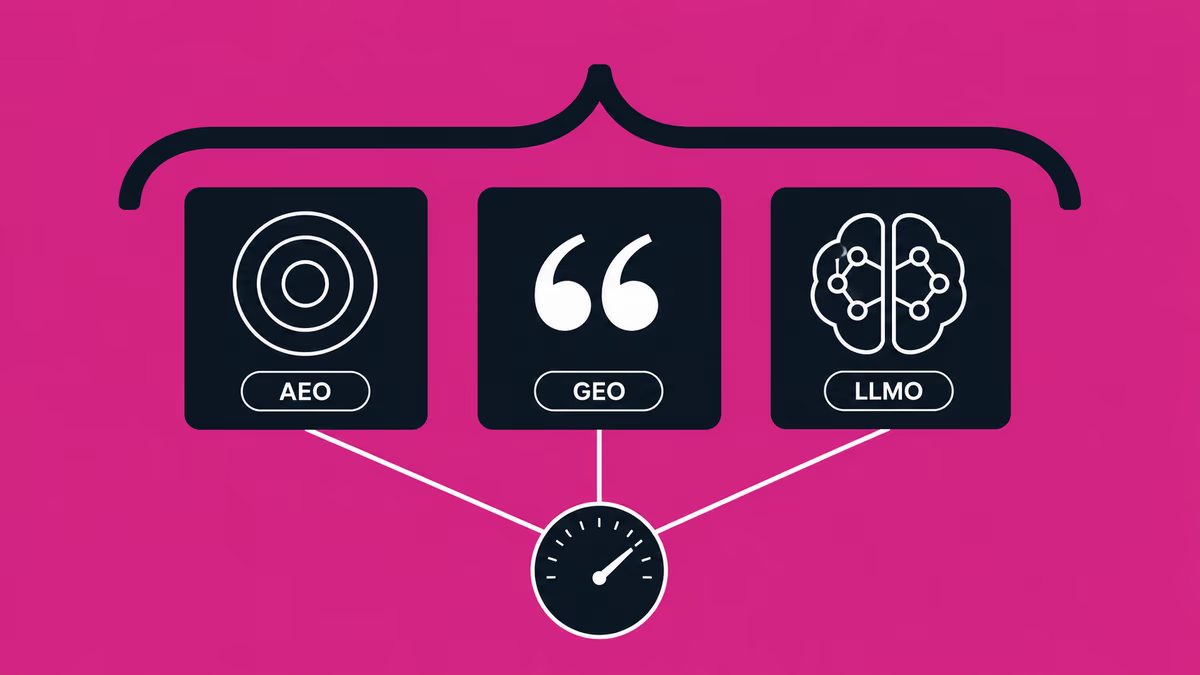
GEO vs LLMO vs AEO (a one-minute untangling)
These three terms get used almost interchangeably in the press, which breeds confusion. The clearest way to hold them apart is by scope. We keep the strict definitions in our AIO glossary; the essentials:
| Term | Full name | Focus |
|---|---|---|
| GEO | Generative Engine Optimization | Being cited and recommended inside generative AI answers |
| LLMO | Large Language Model Optimization | The broader work of getting large language models to understand and retain your information correctly |
| AEO | Answer Engine Optimization | Being selected as the answer to a question — a use-case-specific slice |
In practice, most of the work overlaps across all three, because the conditions for being chosen by AI are the same: trustworthy first-party information, a machine-readable structure, and third-party corroboration. So there’s little point agonizing over “GEO or LLMO” — whatever you call it, the moves are one continuous body of work. (The term itself originates in the 2023 research paper “GEO: Generative Engine Optimization” — Aggarwal et al., KDD 2024.) We’ll use the reader-familiar “GEO” as our lens here.
How to do GEO: six steps
Here’s the work that actually moves the number, in the order it’s most efficient to tackle.
- Diagnose first (before anything else). Ask ChatGPT, Claude, Gemini, and Google AI Overviews the questions a buyer in your category would ask, and record who gets recommended today — and why. This tells you why you’re absent, or why competitors dominate the answer.
- Answer-first structure. Lead each section with a short conclusion. Generative AI extracts quotable passages from long text, so writing that front-loads the point gets picked up more often. Phrase headings as questions and include an FAQ.
- First-party facts. AI wants to cite original data, concrete numbers, and unambiguous facts. Rather than rehashing others, state your own results, research, and pricing with no vagueness.
- Structured data (machine readability). Put down a foundation machines can parse correctly — FAQPage and other structured data, a clean heading hierarchy, and an
llms.txtfor AI agents. Page speed and accessibility matter too: they bear directly on whether AI can read your site at all. - External signals. AI grounds its answers in third-party mentions, not just your own site. Grow the corroboration around you — accurate, consistent company facts (NAP, brand details), earned media, and reviews.
- Measure continuously. Don’t treat GEO as one-and-done. Track your share of voice (how often you appear in answers versus competitors) over time and let it guide the next move. We break the method down in How to measure AI visibility.
Measurement itself can be automated with tooling (including Suparanku, which we co-develop, among a growing set of ways to track AI visibility continuously). But tools only show you where you stand. Why you stand there, and which three fixes to prioritize, is still human judgment — and that judgment is where the value of GEO work sits.
What GEO costs (2026)
Like SEO, GEO pricing scales with the engagement type. The market benchmarks:
| Engagement | Typical cost | Mainly includes |
|---|---|---|
| One-off diagnostic / audit | ¥100,000–500,000 (once) | Current visibility in generative AI search, competitor comparison, improvement roadmap |
| Monthly consulting (retainer) | ¥150,000–800,000 / month | Strategy, recommendations, monthly measurement — usually excludes implementation |
| Implementation-included program | ¥500,000–1,000,000+/mo | The above, plus content and technical implementation done for you |
Public pricing from established vendors — Speee, Faber Company (mieru-ca), and others — lands in roughly the same band. Because the figure swings several-fold on number of engines, number of prompts, and whether implementation is included, always line those assumptions up before comparing vendors. The full breakdown and the traps to avoid are in our LLMO / AIO cost guide.
Our take: ship a moving number, not a report
The classic GEO failure is receiving a polished diagnostic — and then having nobody assigned to implement it, so it dies in a drawer. Most GEO improvements are changes to the site itself. That’s why our position never changes: pay for judgment and implementation, not for raw measurement.
We hand over recommendations as a spec your team — or your existing web vendor — can ship as-is (with implementation by us as an option).
We publish floors and quote by scope. The AI Visibility Audit is free (current visibility, competitor analysis, and a prioritized list of what to fix first, across ChatGPT and Google AI Overviews); the ongoing AIO Program runs ¥500,000+/month. Start by finding out where you stand.
Get your free AI visibility audit →
Limits, and an honest expectation
One thing to be straight about: GEO is not a world where prompt tricks nudge you up the ranking. Keyword-stuffing an llms.txt or seeding fake reviews is high-risk and short-lived — avoid it.
Results also vary by industry and competition. Any “guaranteed +X% in Y weeks” claim is thin, since no vendor controls the AI models’ update cycles from the outside. A realistic frame: foundations in 1–3 months, exposure shifts in 3–6 months, durable model recognition in 6–12 months.
If you would rather have this run for you, our GEO service page sets out how we work through these six steps with a client.
FAQ
What is GEO?
GEO (Generative Engine Optimization) is the practice of getting your information cited and recommended when generative AI search engines — like ChatGPT and Google AI Overviews — compose an answer. Unlike classic SEO, which aims to rank high in the results page, GEO aims to appear inside the AI-generated answer itself.
How much does GEO cost?
On 2026 public data, a one-off audit typically runs ¥100,000–500,000, and monthly consulting (retainer) sits at ¥150,000–800,000. An implementation-included program is roughly ¥500,000–1,000,000+/month. The figure swings several-fold on the number of engines, the number of prompts measured, and whether implementation is included, so compare vendors on the same assumptions. See our cost guide for the breakdown.
How is GEO different from LLMO?
GEO is the use-case-specific term focused on being cited and recommended inside generative AI answers; LLMO is the broader term for getting large language models to understand your information correctly. In practice most of the work overlaps, so it’s fine to treat them as one continuous body of work whichever term you buy under.
Can we do GEO in-house?
Plenty of items — answer-first structure, building out FAQs — are things a team can start on; we list what’s realistic in our in-house LLMO playbook. But root-cause analysis of why competitors get recommended, prioritization, and technical implementation call for specialist judgment. The least wasteful path is to diagnose which fixes matter for your case first, then split in-house from outsourced.
Do we need this on top of SEO?
GEO overlaps with SEO (first-party facts, structured data, quality content) but differs in KPI and tactics, since it targets citation and recommendation inside AI answers. In 2026, most companies start by layering GEO on top of existing SEO. The efficient first move is a diagnostic that shows how far your current SEO assets already carry in generative AI search.