Make AI know your brand correctly
When someone asks ChatGPT "tell me about this company," the model answers from what it learned in training — not from your website. LLMO shapes that training-level knowledge: correcting misinformation, building brand authority and making sure AI speaks about you accurately and favorably.
What is LLMO
The model already has an opinion about your brand
Large Language Model Optimization (LLMO) — coined by Olaf Kopp in 2023 — is the practice of shaping what AI models know about your brand at the parametric level. Unlike GEO (which targets real-time retrieval) or AEO (which targets structured answer surfaces), LLMO works on the model's long-term memory. It is the furthest horizon and the highest-value brand asset in AI optimization.
| Approach | Goal | Where it works | Time to result |
|---|---|---|---|
| LLMO | Shape model's brand knowledge | Model parametric memory | 6–12+ months |
| GEO | Be a cited source in AI answers | ChatGPT, Perplexity, Gemini retrieval | 3–6 months |
| AEO | Be the direct answer | AI Overviews, snippets, voice | 1–3 months |
The problem
What AI says about you is already shaping decisions
Hallucinations & misinformation
AI confidently states wrong features, outdated pricing or non-existent products to prospects — before they even reach your site.
Negative sentiment
In "A vs B" comparison prompts, AI frames your brand with negative qualifiers — or praises competitors at your expense.
Wrong sources quoted
Old aggregator pages and competitor content about your brand are what models learned from — not your own authoritative materials.
Invisible to recruiting
Job-seekers now ask AI "what's it like to work at X?" before applying. If the model doesn't know your employer brand, you lose candidates early.
Framework
AI visibility, measured on five axes
LLMO is where Supasaito's 5-axis framework shines most. Visibility (share of voice) is the north-star metric, but Sentiment and Sources are the specific axes LLMO moves.
What we do
Build the signals AI learns from
Brand knowledge audit
We systematically prompt every major model about your brand and document every wrong claim, negative framing and missing fact — turning invisible problems into a prioritized fix list.
Source & citation building
Authoritative published content on note.com, PR TIMES and industry media gives models accurate, positively-framed source material to learn from at the next training cycle.
Sentiment correction
We create comparison content and third-party coverage that reshapes how models frame your brand in "X vs Y" contexts — shifting tone from neutral or negative to accurate and positive.
Monitoring & alerts
Weekly Supasaito scans flag any new negative outputs or hallucinations as they appear — so you're never the last to know what AI is saying about you.
Use cases
Where LLMO makes the biggest difference
Sales
Buyers increasingly research your brand in ChatGPT before contacting sales. Positive, accurate AI outputs mean you arrive at the first meeting already favorably positioned.
Recruiting
Job-seekers ask AI "what is it like to work at this company?" before applying. LLMO shapes that answer toward your actual employer brand.
Brand protection
Correct hallucinations before they spread into your prospects' expectations. The longer misinformation sits in model outputs, the harder it is to correct.
IR & reputation
Investors and analysts use AI to pre-screen companies. Accurate, complete brand knowledge in models protects your valuation story.
Why Supasaito
Japanese-native LLMO, backed by Supasaito
Japanese-native analysis
We track every spelling variant (カナ・漢字・ローマ字), honorific nuance and brand name form. Supasaito was built for the Japanese market from day one.
We built the measurement platform
Supasaito measures your Sentiment and Sources axes weekly across every major model. You see exactly what's changing and why — not a quarterly slide deck.
Agency execution, not just reports
We produce the content, coordinate PR placements and implement technical signals ourselves — end to end, not just an audit you have to action alone.
FAQ
Common questions about LLMO
- What is LLMO exactly?
-
Large Language Model Optimization — the practice of shaping what the model itself knows about your brand, via training data signals and durable brand presence across the web. Coined by Olaf Kopp (Search Engine Land, Oct 2023).
- How is LLMO different from GEO?
-
GEO targets real-time AI search results (what the model retrieves and cites today). LLMO targets the model's parametric memory — what it "knows" from training. LLMO is the furthest-horizon work; GEO shows faster results but doesn't shape long-term brand perception the way LLMO does.
- Can you fix AI hallucinations about our brand?
-
Yes — that is one of the main LLMO deliverables. We identify the wrong or missing information in AI outputs, build authoritative correction signals (published content, citations, entity data) and monitor until the model updates.
- Which AI models does LLMO cover?
-
ChatGPT (GPT-4/4o), Claude, Gemini and others. Each model has its own training cycle, so corrections propagate at different speeds — we track all of them via Supasaito.
- How long until results?
-
LLMO is the longest-horizon discipline: 6–12+ months for durable model-level changes. Brand perception shifts are real but slower. We track weekly signals so you can see progress before the full payoff.
- What is "AI visibility" and how do you measure it?
-
AI visibility is the share of AI answers (across target prompts) that mention your brand — the north-star KPI across all AI optimization work. We measure it weekly across engines using Supasaito, broken down by Visibility, Rank, Sentiment, Competitors and Sources.
Related disciplines
LLMO is one part of AI Optimization
AEO
Answer Engine Optimization — get cited as the direct answer in Google AI Overviews and voice search. Fastest results.
Learn moreGEO
Generative Engine Optimization — become a cited source in ChatGPT, Perplexity and Gemini answers.
Learn moreAIO
AI Optimization — the umbrella covering all three disciplines together. See the full picture.
Back to AIO hub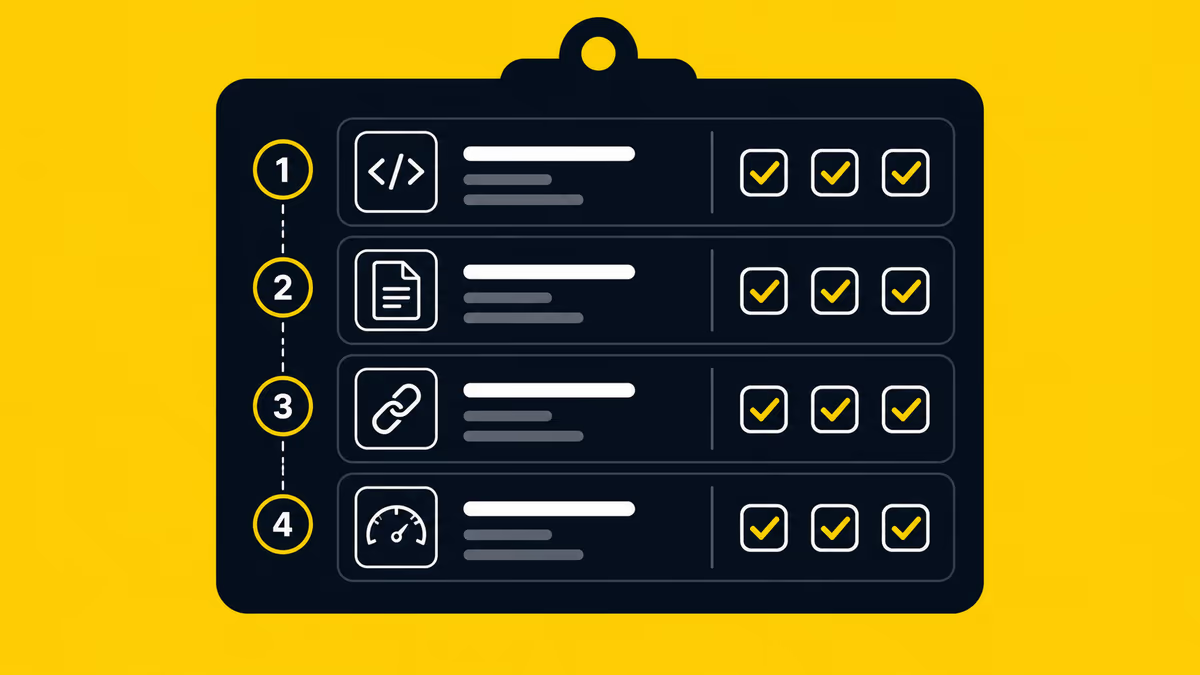 AI & Search Visibility
 How To Do LLMO in 2026: Where To Start, and 12 Steps You Can Do In-House
How to do LLMO / AI search optimization: a 5-step way to start, plus the 12 steps you can run in-house and the areas worth outsourcing — across four layers: structure, content, off-site signals, measurement. From Supasaito, who run a free AI Visibility Audit.
 AI & Search Visibility
 How Much Does LLMO / AI Search Optimization Cost in Japan? (2026)
What LLMO / AIO optimization actually costs in Japan in 2026, based on public pricing. A one-off diagnostic runs ¥100K–500K; monthly consulting sits at ¥150K–800K. The price breakdown, how to choose, and what to check before you buy — from Supasaito.
 AI & Search Visibility
 8 Best LLMO / AI Search Optimization Agencies in Japan (2026)
Choosing who runs your AI-search visibility in Japan, from outside the market. Eight LLMO / AIO firms compared on public data against five criteria — plus the three things that behave differently in Japan: the domestic sources AI cites, Japanese spelling variants, and why translated content is not cited. By Supasaito, a bilingual Tokyo team that implements, not just measures.